AI and the Future of the Product Role
NOTE: This is a narrative form of a keynote for the 2026 Product Leader Summit.
Overview
Most people in the industry realize that the job definition and responsibilities of the people in the product role can vary widely across companies.
This has always been true, in no small part due to inheriting the job title “product manager” from consumer packaged goods companies, which has never been a great match for those of us building technology-powered products and services.
Many people have suggested over the decades that the various job descriptions are so different that perhaps they should each have different names.
I had always believed that it would be very hard to get an entire industry to change something as entrenched as one of the major job titles, and that it likely wouldn’t be worth the effort.
I’m no longer so sure about that.
Today we have the situation where some major industry leaders proclaim the product role is dead, and others proclaim that it’s the single most important role going forward. Each very likely assumes the other is clueless.
What most don’t realize, including many of the industry leaders, is that the operating model a company uses to create products is what drives the roles and responsibilities of the members of the teams, and we have long had two very different operating models in play.
This has caused some relatively minor confusions when it comes to the role of product designers and engineers, but it has caused very significant confusion when it comes to the role of the product manager.
Beyond the long-standing confusion, AI is now shining a very bright light on this topic, and finally forcing the industry to take a hard look at this role.
That hard look is the subject of this article.
The Three Different Definitions of the Product Role
The most fundamental reason there are different definitions of the product role is because there are different operating models for creating products, and the operating model drives what roles and skills are needed.
When using the project model, there are two different product roles, although it is not uncommon for companies to have both: the feature team product manager and the agile product owner.
When using the product model, we have the empowered team product manager.
Each of these three roles has very different responsibilities and requires very different skills, yet so many in the product community seem to behave as if there is only one (usually the one they are doing).
Note that I am not including product leaders here; I’m just speaking to the people responsible for product creation.
In addition to trying to clearly state the differences between the three roles, I will share my view on AI’s impact to each: which versions of the role we can expect will lose their relevance and are likely to disappear, and which will become increasingly important and prominent.
The Project Model
In a company using the project model, the product roadmap contains prioritized features and projects, which are each a hoped-for solution to some usually unstated problem. Projects and features are funded and staffed, and success is defined by shipping this solution.
The job of the feature team is to design, build, QA test, and deploy that particular hoped-for solution. There is very little, if any, product discovery because the solution has already been prescribed. It’s all about turning this feature or project into a solution that can be shipped (aka build to earn).
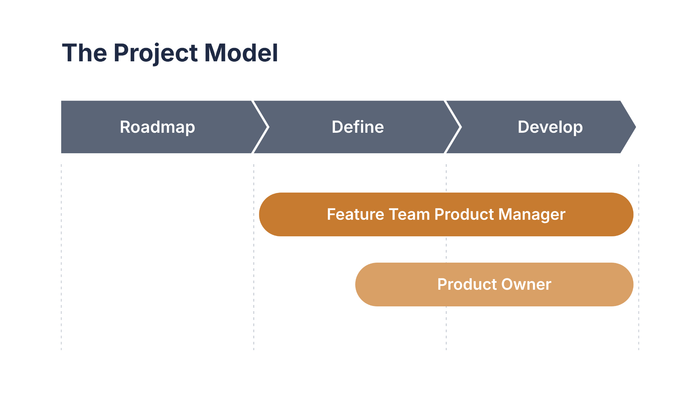
The Feature Team Product Manager role:
The job of the feature team product manager in this model is to marshal and coordinate the resources required to get this solution designed, built, tested, and shipped.
In this situation, the feature team product manager is essentially playing a project management role to drive the execution. This often includes helping out wherever needed, which is why these people can end up writing documentation one day, performing QA the next day, and committing simple front-end code changes the next.
Today companies are racing to use agentic AI to automate as much of the delivery process as possible, striving to create a software factory where agents handle the work that was previously handled by developers, QA, release managers, and feature team product managers, and engineers oversee and direct the various agents performing these tasks.
It is clear that there is less need for feature team product managers, but it is less clear how many may still be needed to provide some level of oversight beyond what the engineers and their agents can do.
The Product Owner role:
For project model companies using Agile (like Scrum or Kanban) or SAFe, this is a role in the delivery process, managing the delivery backlog, and coordinating with the engineers before, during and after sprints.1
Today, with AI disrupting the delivery process by both automating and accelerating the engineering activities and workflows, and with so much of the sprint process obviated, the product owner role is already being phased out.
The Product Model
In a product model company, the product strategy identifies the most important problems to solve, and the product leaders assign these problems-to-solve, along with an associated desired outcome, to product teams.
Success is defined by achieving that outcome.
Now that companies have come to realize that the bottleneck is no longer product delivery, the real question is determining what to build. This means product discovery, which depends on people with the necessary skills and knowledge of the craft.
Product discovery still involves building, but it is a very different type of building, known as build to learn.
Moreover, the craft of product discovery involves not just fleshing out product ideas, often with prototypes, but testing those prototypes on users and customers (for value and usability), stakeholders (for viability), and engineers (for feasibility). Product managers trained on product discovery techniques have a range of qualitative and quantitative techniques for rapidly and safely testing these ideas against these risks.
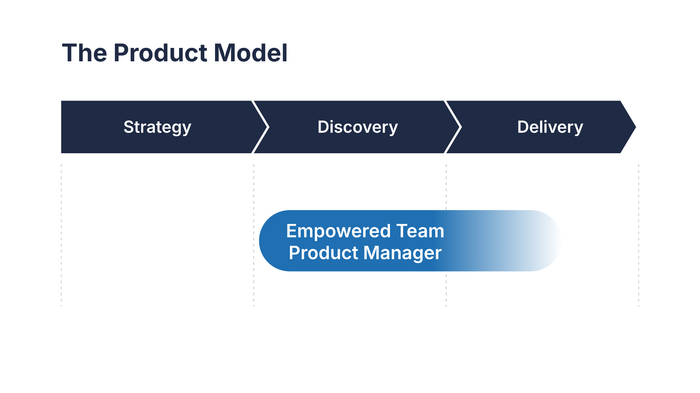
The Empowered Team Product Manager role:
The primary responsibility of an empowered team product manager is to help discover a solution that will solve the problem and achieve the outcome. In order to do this, the product team needs a cross-functional range of skills.
While an engineer (usually the tech lead) covers technical feasibility, and the product designer covers the necessary user experience, the product manager needs to bring deep knowledge of the industry, the market, the domain, and the customer, especially as it relates to value, along with broad knowledge of the many dimensions of business viability (including sales, marketing, finance, monetization, legal, compliance, security, and privacy).
Currently, and likely for the next several years at least, the empowered team product managers are in especially high demand as they bring the product sense required for value and viability, and the skills and techniques of product discovery.
This is true with all products, including conventional (deterministic) products, but it is especially critical for probabilistic products, where the viability risks of unit economics, legal liability, safety, privacy, compliance and ethics can be considerable. This is also why the empowered team product manager is necessarily at the center of the eval process for a probabilistic product.2
An AI Product Coach can help in developing the necessary product sense, and it helps in the activities of product discovery.
While product delivery is defined by essential workflows and thus well-suited to automation with agentic AI, the product discovery activities are much less defined by workflows, and much more by product sense and judgement.
AI still plays a strong role in assessing and understanding market dynamics, competitive landscapes and customer behaviors, and in helping the empowered team product manager to develop the relevant product, business, domain and industry knowledge to make good judgements.
Moving Forward
So what is the future of the product role? I expect a very different future for each of the three product roles. We’ll start with the good news:
Empowered Team Product Managers: So long as the bottleneck is no longer product delivery, I expect the focus will necessarily be on the skills and techniques to determine the right product to build – the craft of product discovery. And I expect this will continue to increase the demand for people with this knowledge and skills.
Feature Team Product Managers: The future is least clear here. For companies that choose to move to the product operating model, I expect most of these people will continue to upskill to empowered team product managers. However, as much as I would love to believe that companies will finally abandon the project model and move to the product model, I know that for many, if not most, companies, it will likely never happen.3 Yet with the automation of so many of the feature team product manager responsibilities, it’s unclear just how much will be left.
Product Owners: The trend here has been clear for the past couple of years, and I have been strongly encouraging product owners to upskill as fast as possible. In any case, I believe the dedicated product owner role will resolve itself.
While the underlying dynamics may have been in place for several years, AI has brought the issue to the forefront, and many are experiencing the consequences for the first time.
Shreyas Doshi recently highlighted this realization when he called out the difference between product managers focused on outcome (success) versus output (execution):
“Product Managers who’ve historically viewed their role as “my main job is to execute” are finding it way harder to get hired at top companies than those who’ve viewed their role as “my main job is to make the product successful”. For a couple of decades now, many companies (and leaders) were explicitly or implicitly giving PMs the unfortunate message that a PM’s main job is execution. The truth is that execution, while extremely important, was never a PM’s main job. Enabling product success was always the main job.”
While helping to automate the software factory is a worthy and valuable initiative, if product people understand that their higher order responsibility is to ensure product success (achieve the necessary outcome), then their focus needs to instead be on helping to discover a solution worth building.
- In both project model and product model companies, when the engineers are using an Agile process for delivery, the product manager normally covers the product owner responsibilities. We’re discussing here the situation where a company has either dedicated product owners, or both product managers and product owners.
↩︎ - For those that haven’t been exposed to building probabilistic products, the eval process is how we determine whether a result would be considered good or even acceptable. While this is straightforward with deterministic products, it can be much more complicated for probabilistic products where the results can be much less predictable.
↩︎ - This is primarily due to the desire for predictability. ↩︎